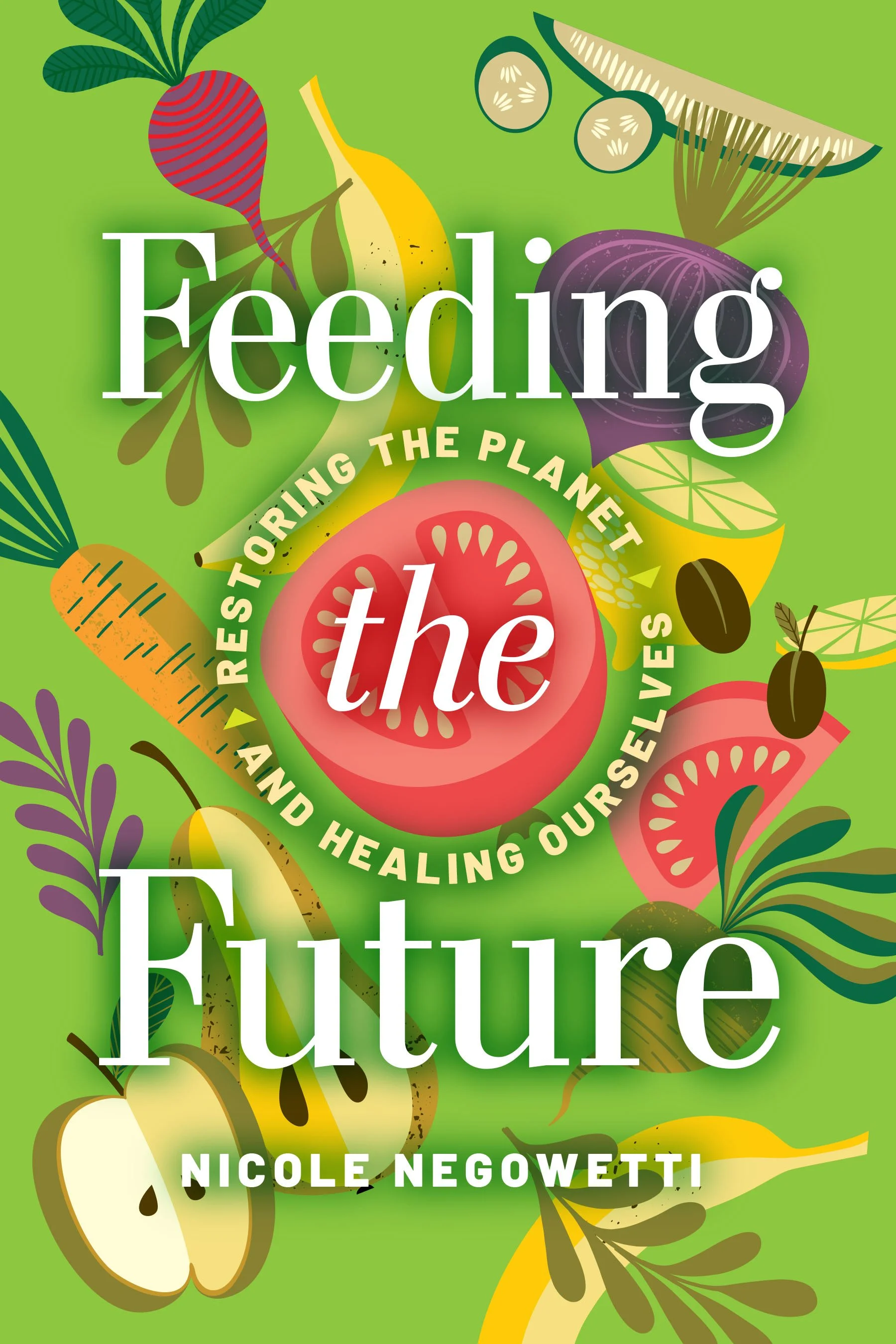
Feeding the Future: Restoring the Planet and Healing Ourselves
By Nicole Negowetti (Georgetown University Press, 2026)
A Book About Food Systems, and a Map for Navigating Civilizational Threshold
Feeding the Future began as an inquiry into food system reform.
It became an inquiry into civilizational orientation.
What started as a legal and policy investigation gradually widened into a deeper question:
Why do technical solutions and regulatory reforms, however necessary, repeatedly fail to address the underlying drivers of ecological and social breakdown?
Written at the intersection of food systems, ecological economics, systems theory, and regenerative worldviews, the book traces a shift from reforming institutions to examining the paradigms that shape them.
It lays the intellectual and ethical groundwork for my current work on coordination under threshold conditions.
The Core Insight
For years, I worked from a familiar premise: If we produce better evidence, design better regulations, and raise public awareness, we can transform systems.
But as the research deepened, and as I listened to farmers, land stewards, policymakers, and community leaders, it became clear:
Knowledge alone does not shift systems built on extraction, disconnection, and institutional distrust.
The crises within the food system are not isolated failures. They are expressions of deeper organizing logics:
Human separation from the living world
The primacy of yield and efficiency over relationship
Technological solutionism
Linear, compartmentalized thinking
Economic models that assume endless growth on a finite planet
These paradigms shape how we farm, legislate, organize, parent, research, and imagine the future.
Until they are examined, reform remains partial.
Key Themes
1. Paradigm Shift as the Deep Leverage Point
Drawing on systems thinkers such as Donella Meadows, the book argues that the deepest leverage for change lies not in surface interventions, but in the worldviews beneath them.
Threshold times require work at that depth.
2. Regeneration as Orientation, Not Technique
Regeneration is often framed as a set of agricultural practices.
The book situates it more broadly, as an epistemic and cultural reorientation toward reciprocity, relationality, and long-term stewardship.
This orientation becomes essential when systems are destabilizing.
3. The Limits of Technical Fixes
Technological innovations and policy reforms can reduce harm.
But when they operate inside extractive paradigms, they often reproduce the conditions that generated crisis in the first place.
Understanding this tension is critical for navigating transition responsibly.
4. Meaning, Agency, and Active Hope
Drawing on Joanna Macy’s concept of Active Hope, the book explores how people can see clearly, orient toward what they value, and act without certainty.
Threshold conditions demand precisely this: clear-eyed realism coupled with disciplined hope.
5. Transformation Through Shared Material Reality
Change does not emerge primarily through argument. It emerges when people encounter the living systems they depend on, including soil, water, and community, and reorient through direct engagement.
This insight later became central to my work on coordination across difference.
Why This Book Matters Now
We are entering a period marked by:
Ecological destabilization
Epistemic fragmentation
Institutional erosion
Economic precarity
A widespread crisis of meaning and belonging
Feeding the Future helps readers understand how we arrived at this threshold.
It also offers an alternative orientation, rooted in relationality, regeneration, and long-horizon stewardship.
In this way, the book serves as a compass for navigating systemic transition.
Who the Book Is For
Food system practitioners and policymakers
Regenerative farmers and land stewards
Scholars of law, ecology, political economy, and systems change
Organizers and bridge-builders navigating fragmentation
Readers seeking grounded ways to orient in uncertain times
Anyone attempting to understand our civilizational moment